A Skeptic's Guide to the Steam Awards: When Fan Votes Turn into Inside Jokes
The Steam Awards deliver a uniquely democratic, bewildering spectacle as video game accolades, blurring lines between sincere praise and ironic community votes.
In the grand, chaotic circus of video game accolades, the Steam Awards stand out as a uniquely democratic, and consequently, utterly bewildering spectacle. While the author professes a distinct lack of saltiness, a deep-seated curiosity bubbles to the surface: were the latest batch of winners selected with genuine admiration, or were they the products of a massive, coordinated prank? The line between sincere praise and sardonic commentary has never been blurrier, casting a shadow of delightful suspicion over the entire affair. After all, when the community holds all the power, the results can be as unpredictable as a rogue crit in a hardcore permadeath run.
The Unambiguous Prank: A 'Labor of Love' or a Labor of Spite?
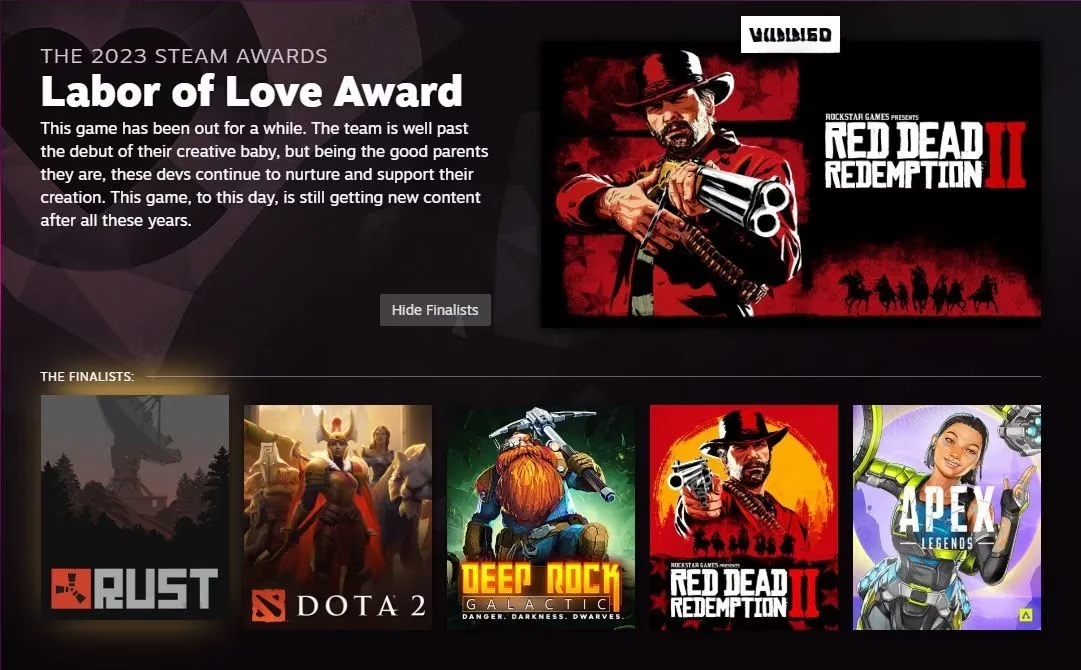
Let's address the digital elephant in the room first. The award for 'Labor of Love' going to Red Dead Redemption 2 is, without a shadow of a doubt, the gaming equivalent of giving a 'World's Best Boss' mug to Michael Scott from The Office. It's a masterclass in ironic voting. The award's description poetically speaks of developers who "continue to nurture and support their creation" with new content years after launch. The community's response? A collective, knowing chuckle. Red Dead Online, the game's multiplayer component, has been in a state of official content abandonment for over two years. The idea that it represents ongoing, loving support is so divorced from reality that it can only be interpreted as a massive, community-wide troll intervention—a spiteful homage to what could have been.
The Suspicious Contenders: Innovation or Irony?
If one award is clearly a joke, it forces us to squint suspiciously at the others. Take 'Most Innovative Gameplay' awarded to Starfield. Now, Bethesda's cosmic RPG has its ardent admirers, but its gameplay mechanics—the very core of the 'innovation' award—were widely critiqued for feeling like a polished iteration of a decades-old formula rather than a bold leap forward. Giving Starfield this particular accolade feels less like praise and more like a subtle, community-sourced roast. It's akin to handing The Legend of Zelda: Tears of the Kingdom a prize for 'Most Original Open World' (a title that practically defines it) or praising Overwatch 2 for having the 'Least Exploitative Microtransactions'—a statement so loaded it could power a small city.
The Genuine Head-Scratchers
Then there are the winners that simply leave one baffled, existing in a nebulous zone between legitimate and ludicrous.
-
Hogwarts Legacy for 'Best Game on Steam Deck': This one is a true enigma. The game isn't famously optimized for handheld play like many roguelites or cozy sims. Its victory here prompts more questions than celebrations. Was it a testament to surprising post-launch optimization, or did it simply benefit from a massive fanbase voting across categories? The silence surrounding its Steam Deck performance is deafening.
-
Atomic Heart for 'Outstanding Visual Style': Sure, the game has those funky, ballet-dancing robots and a distinct Soviet retro-futurist aesthetic. But with visually groundbreaking titles like Hi-Fi Rush right there, this win feels more like a recognition of 'most memorable art direction' rather than outright visual superiority. It gets a pass, but a side-eyed one.
The Makes-Sense Brigade
Amidst the chaos, some awards land with satisfying clarity. These are the victories that feel earned and logical:
| Award | Winner | Why It Makes Sense |
|---|---|---|
| Better With Friends | Lethal Company | This co-op horror sensation was a viral social phenomenon, perfectly capturing the 'friends screaming together' vibe. |
| Sit Back and Relax | Dave the Diver | Managing a sushi restaurant by day and exploring the deep sea by night is the definition of chill, engaging gameplay. |
| Outstanding Story-Rich Game & Game of the Year | Baldur's Gate 3 | A near-universal critical and commercial darling. These wins are as uncontroversial as finding a health potion when you're near death. |
The Ripple Effect of a Single Troll
The core issue is one of contamination. A single, successfully executed joke vote—like the Red Dead Redemption 2 situation—compromises the integrity of the entire awards show. It transforms the ceremony from a celebration into a puzzle box where every winner must be scrutinized for hidden meaning. Is Valve in on the joke, crafting cheeky descriptions with a wink? Or are they merely presenting the results with a straight face, allowing the community's chaotic energy to speak for itself? Major companies like Bethesda proudly promote these awards, seemingly unaware that they might be the butt of the joke. This disconnect between corporate celebration and communal satire is the most fascinating, and perhaps the most telling, aspect of the whole event.
In the end, the Steam Awards serve as a perfect snapshot of modern gaming culture: passionate, opinionated, and with a wicked sense of humor. They remind us that while golden statues and industry panels have their place, there's something uniquely compelling about handing the microphone directly to the players. You might not always get the result you expect—sometimes you get heartfelt praise, and sometimes you get a brilliantly executed, community-wide meme. And maybe, just maybe, that's exactly how it should be. :video_game: :trophy: :thinking_face: